


Santa's Nine Reindeer: Their Names, Where Rudolph Came From, and What Real Reindeer Are Like
Santa Claus has nine reindeer. Eight of them were named in a poem printed in 1823, and the ninth, Rudolph, arrived in 1939 as a free booklet handed out by a Chicago department store.
Here are the nine names in the order the poem gives them, what each name means, where Rudolph came from, and what real reindeer are like, from eyes that change colour to the antler question that decides whether Santa's team is male or female.
And if you would rather meet the herd in cotton before you meet it in history, it is right here.
Santa's reindeer names, in the order of the poem

The eight original names come from "A Visit from St. Nicholas", printed anonymously in the Troy Sentinel of Troy, New York, on 23 December 1823. Clement Clarke Moore was first named as the author in 1837 and included the poem in his own collection in 1844, saying he wrote it to amuse his children.
The line as printed in 1823 reads: "Now! Dasher, now! Dancer, now! Prancer, and Vixen, / On! Comet, on! Cupid, on! Dunder and Blixem."
Dasher, Dancer, Prancer and Vixen
Dasher is one who dashes, moving very fast. Dancer is one who dances. Prancer is one who prances, with a showy, springing step.
Vixen is the odd one out. The word means a female fox, from the Old English fyxen.
Comet and Cupid
Comet comes from the Greek kometes, a "long-haired star". Cupid is the Roman god of love, from the Latin cupere, "to desire".
Dunder and Blixem, who became Donner and Blitzen
The last two are the ones most people get wrong. In 1823 they were Dunder and Blixem, from the Dutch oath "Donder en Blixem", thunder and lightning.
By one account, the 1837 anthology printed them as Donder and Blixen, so that Blixen would rhyme with Vixen. Moore's own 1844 edition gave "Donder and Blitzen", with Blitzen matching the German word for lightning.
Donner, the modern German word for thunder, became the standard spelling in the 20th century. The pair has meant thunder and lightning in every version; only the language changed.
Rudolph, the ninth
Rudolph is the one name missing from the poem. He was added in 1939, which makes him the ninth and youngest of the team. The name comes from the Old High German Hrodulf, "fame" and "wolf".
Where Santa's reindeer came from
The first reindeer in print is older than the poem. In 1821, an anonymous illustrated poem called "Old Santeclaus with Much Delight" appeared in a New York children's book, The Children's Friend. Its opening lines read "Old Santeclaus with much delight / His reindeer drives this frosty night", and the picture shows a sleigh pulled by a single, unnamed reindeer.
Two years later the 1823 poem raised the count to eight and gave them names. No known source explains why either author chose reindeer rather than horses.
What the sources do say is that by the 1820s Santa was already associated with reindeer and, through them, with the cold north where reindeer live. Thomas Nast's Harper's Weekly cartoon of December 1866 then placed him at the North Pole, the most remote cold place of all.
Rudolph: where the red-nosed reindeer came from

A free booklet from a Chicago store, 1939
Rudolph was created in 1939 by Robert L. May, a 34-year-old copywriter at Montgomery Ward in Chicago. The store had been buying colouring books to give away to children each Christmas and wanted a story of its own instead.
May considered the names Rollo and Reginald before settling on Rudolph. He wrote the story partly for his daughter Barbara, at a time when his wife was seriously ill.
The plot is the one you know: a young reindeer with a glowing red nose, and a foggy Christmas Eve when Santa needs that light to guide the sleigh. Montgomery Ward gave away 2.4 million copies in 1939, and over 5 million were in print by 1946.
The copyright, the song and the TV special
In January 1947 Montgomery Ward returned the copyright to May. His brother-in-law Johnny Marks turned the story into a song, and Gene Autry recorded "Rudolph the Red-Nosed Reindeer" in 1949. It reached No. 1 on Billboard the week of Christmas 1949 and sold about 2 million copies in its first season.
The stop-motion TV special premiered on NBC on 6 December 1964, narrated by Burl Ives as Sam the Snowman, and it is the longest continuously running Christmas TV special in the United States. That special is where Clarice, Rudolph's doe sweetheart, comes from, and where the idea that Rudolph is Donner's son appears. Neither detail is in May's original booklet.
What real reindeer are like

Behind the legend is a real Arctic animal, and it is at least as remarkable as Rudolph.
Reindeer and caribou are the same animal
The species is Rangifer tarandus, named by Linnaeus in 1758. "Reindeer" is the European name; in North America the wild animal is called caribou and only the semi-domesticated form is called reindeer.
They live across the Arctic and subarctic: Scandinavia, Siberia, Alaska, Canada and Greenland. Bulls average 159 to 182 kg and cows 80 to 120 kg, with a body length of 150 to 230 cm.
Both sexes grow antlers, which raises a question about Santa's team
Reindeer are the only deer species in which females grow antlers. Males carry the larger set, up to 130 cm long and 15 kg; a female's antlers reach about 50 cm.
The timing is the interesting part. Males drop their antlers after the autumn rut, between late October and mid December depending on the source, while females keep theirs through the winter and shed around calving in late May or June.
So a reindeer still wearing antlers on 24 December is, by biology, most likely female. It is a common joke for a reason, and it means Dasher, Dancer and the rest of Santa's December team may well be does.
Alaska's Department of Fish and Game even keeps a tongue-in-cheek species profile for Santa's reindeer, noting their "extremely velvety and robust" antlers in late December and a December diet "almost entirely of carrot snacks".
Eyes that turn from gold to blue
A reflective layer at the back of the reindeer's eye, the tapetum lucidum, is gold in summer and deep blue in winter. The blue version scatters more light through the retina, which raises sensitivity during the months of Arctic darkness.
The change was shown by Professor Glen Jeffery of UCL with the University of Tromsø in 2013, and it was the first colour change of this kind recorded in a mammal.
Ultraviolet vision and a nose built for the cold
The same UCL team showed in 2011 that reindeer see ultraviolet light down to 320 to 350 nanometres, something almost all other mammals cannot do. Against snow, that makes lichen, urine and wolf fur stand out. Reindeer are one of very few mammals with this ability.
The nose is real science too. A broad muzzle and a large nasal cavity warm and moisten the freezing air before it reaches the lungs, and reindeer noses have about 25 percent more capillaries than human noses. On a thermal camera they glow red.
Speed, migration and reindeer moss
A reindeer can run at up to 80 km/h and swim at 6 to 10 km/h. Some herds make round-trip migrations of more than 1,200 km, the longest land migration of any mammal according to a 2019 study.
In winter they dig through the snow with their hooves for lichen, known as reindeer moss (Cladonia rangiferina), plus dried sedges and small shrubs. Summer brings willow leaves, sedges, tundra flowers and mushrooms, about 5.4 kg of food a day.
Reindeer in Thailand
We found no reindeer listed at any Thai zoo. Thai children meet them instead as December decor in the malls and on screen.
In Thai the animal is กวางเรนเดียร์ (reindeer), and the wild North American form is กวางคาริบู (caribou), which you will also see spelled กวางแคริบู (caribou). National Geographic Thai uses the first spelling and separates the domesticated reindeer from the wild caribou.
Thai Wikipedia's article on กวางเรนเดียร์ (reindeer) gives no names, no count and no Rudolph, and it places the animal in Australia and Antarctica, where no reference source places it.
Our reindeer are Thai. Each one is handmade in cotton by Akha women in Asha village, Chiang Rai, through our Akha Ma-De programme, and the first two you should meet are Rudolph and Dasher.
Our herd, made in Chiang Rai
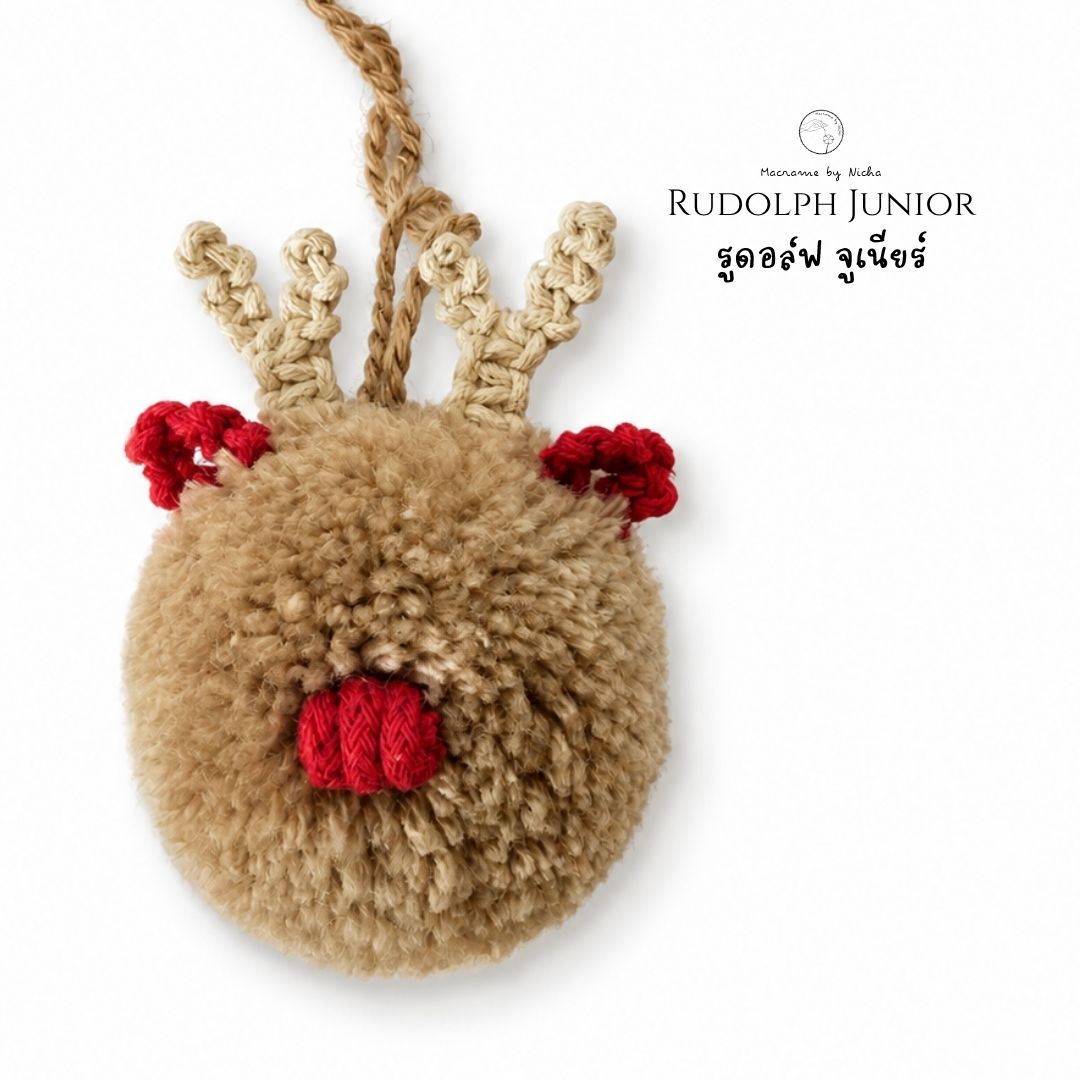
Every reindeer in our collection is made to order, by hand, in cotton: you tell us how many you need and we make them.
- Rudolph and Dasher, THB 199, 10 x 11 cm, in green or blue
- Rudolph Junior, THB 159
They belong with the rest of the sleigh. Read who Santa Claus is and where he lives, find out what a Christmas stocking is for, and meet Santa's seven dwarf helpers.
Questions people ask
How many reindeer does Santa have?
Santa Claus has nine reindeer. Eight of them were named in the poem "A Visit from St. Nicholas", printed in the Troy Sentinel on 23 December 1823. The ninth, Rudolph, was created in 1939 by Robert L. May for a Montgomery Ward booklet, which makes him the youngest of the team.
What are the names of Santa's reindeer in order?
In the order of the 1823 poem: Dasher, Dancer, Prancer, Vixen, Comet, Cupid, Donner and Blitzen, then Rudolph as the ninth. The last two were printed as Dunder and Blixem in 1823, Dutch for thunder and lightning, and became Donner and Blitzen through later editions.
Is Rudolph a boy or a girl?
In the story Rudolph is a boy, in May's 1939 booklet, in the 1949 song and in the 1964 TV special where Clarice is his doe sweetheart. Biology says otherwise: a reindeer still wearing antlers at Christmas is almost certainly female, since males drop theirs after the autumn rut.
Are Santa's reindeer real?
Reindeer are real animals, Rangifer tarandus, living in Arctic Europe, Siberia, Alaska, Canada and Greenland. The flying, the sleigh and the names are storytelling: one reindeer in an 1821 New York poem, eight named in the 1823 poem, and Rudolph from a 1939 booklet written by Robert L. May.
What do reindeer eat?
In winter reindeer eat lichen, called reindeer moss (Cladonia rangiferina), which they dig out from under the snow with their hooves, along with dried sedges and small shrubs. In summer they switch to willow leaves, sedges, tundra flowers and mushrooms, eating about 5.4 kg of food a day.
Do female reindeer have antlers?
Yes. Reindeer are the only deer species in which females grow antlers. Males grow the larger set, up to 130 cm and 15 kg, and drop them after the autumn rut. Females grow antlers up to about 50 cm and keep them all winter, shedding around calving in late May or June.
If your sleigh this year needs a Thai reindeer or two, we would love to make them for you. Everything is made to order.